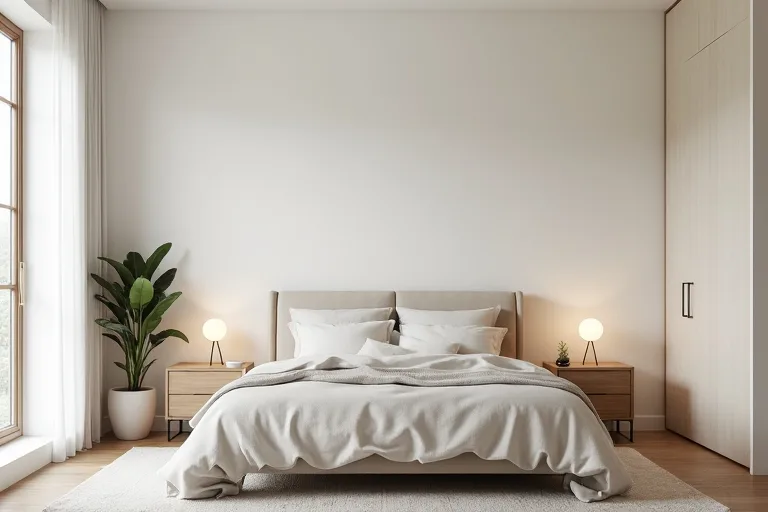
The easiest way to miss the mark with a minimalist bedroom is to start with pretty pieces and hope they fit. A calmer result usually comes from a simple order: measure the room, confirm the bed size, plan storage, then choose lighting and decor that support the layout.
This checklist keeps the decision practical. It helps you work out what the room actually needs before you spend money on furniture that looks good online but feels too heavy, too small, or too crowded at home.
Start with layout, bed size, storage, and layered lighting before buying decor. In a minimalist bedroom, the room plan matters more than the shopping list.
1. Check the room before you shop
Minimalist bedrooms work best when the furniture has room to breathe. Before you look at beds, lamps, or storage, measure the room and note the placement of doors, windows, radiators, and built-ins. Then think about how you move through the space. If you have to sidestep furniture every day, the room will feel busy even with very few items.
It also helps to mark the main walking path on paper or in a planner. That makes it easier to see whether one larger piece is better than several smaller ones. In many bedrooms, less clutter comes from smarter sizing, not from owning fewer things at random.

If the room feels tight on paper, it will feel tighter once storage baskets, bedside tables, and lamps are added. The real question is not whether the room can hold furniture, but whether it can hold furniture and still feel easy to use.
2. Choose the right bed and furniture scale
The bed usually defines the whole room, so it is worth deciding on that first. A queen bed may be the right choice in one bedroom and too dominant in another. If you are trying to keep the space calm, the frame style matters as much as the size. A simpler upholstered frame can soften the room without adding visual noise, especially when the bedding stays neutral.
After the bed, check the scale of the rest of the furniture. Nightstands should support what you actually use at bedtime, not just fill the space. If you need room for a lamp, a book, a glass of water, and a charger, the surface should be planned for that instead of treated as decorative space.
- Confirm the mattress size you need.
- Check how much clearance you want around the bed.
- Choose bedside tables that fit the room, not just the wall.
- Keep other furniture pieces simple and purposeful.

3. Plan storage and lighting together
Minimalism usually fails when storage is an afterthought. If surfaces have nowhere to send daily clutter, the room quickly stops feeling calm. Before you buy anything, decide what needs to be hidden, what can stay visible, and what should live elsewhere. Closed storage is often the easier choice for a bedroom because it keeps the visual field quieter.
Lighting needs the same level of planning. One ceiling light is rarely enough for a bedroom that is meant to feel restful and functional. Layered lighting makes the space more usable: general light for the room, bedside light for reading or winding down, and softer light for evenings when you want the room to feel less bright. A matching set of bedside table lamps can do a lot of work without adding visual clutter.
If you are unsure how much storage you need, map out the things you actually keep in the room: clothes in rotation, extra bedding, books, chargers, and anything else that tends to spread across surfaces. Then choose storage that handles that list without forcing you to overfill every drawer.
4. Keep decor simple and consistent
Once the room is sized and the furniture is planned, decor becomes easier to edit. In a minimalist bedroom, the goal is not to leave the space bare. It is to choose a few calm, useful pieces that work with the room rather than compete with it. A plant, a lamp, a tray, a woven basket, or a single framed print can be enough.
Materials matter too. Repeating the same few finishes across the room keeps everything cohesive. Soft neutrals, natural wood, matte metal, or textured fabric usually read as quieter than a mix of many different finishes. If the room already has a strong visual feature, such as a large window or an upholstered bed, let that lead and keep the rest simple.

For a practical finish, choose decor after the layout is set. That makes it easier to stop buying pieces that seem useful individually but do not add up to a coherent room.
Best next step
If you want to avoid buying the wrong size or too much furniture, map the room first and then set a simple budget for the pieces that matter most. That gives you a clearer order for shopping and helps the bedroom stay minimal in real life, not just in mood boards.
- Buying decor before the bed size and layout are fixed.
- Choosing a bed that leaves too little walking space.
- Ignoring storage, then letting surfaces collect clutter.
- Relying on one ceiling light instead of layered bedroom lighting.
- Mixing too many finishes, which makes the room feel busier than it needs to be.
A minimalist bedroom feels calm when the plan comes first. Measure the room, confirm the bed size, sort out storage, and build a simple layered lighting setup before you buy decor. That order keeps the room functional and makes every purchase easier to justify.
Helpful next tools and planners
If you want to make the decision easier before you buy
These are useful if you are still comparing layouts, costs, or the right mix of bedroom pieces. The goal is to buy less, but buy better for the room you actually have.
FAQ
What should I decide first in a minimalist bedroom?
Start with room measurements, then choose the bed size, storage plan, and lighting. Decor should come after the room has a clear layout.
Is a queen bed too big for a minimalist bedroom?
Not always. It depends on the room size and how much walking space remains around it. A queen can work well if the rest of the furniture stays simple.
Do minimalist bedrooms need bedside tables?
Usually, yes, if you need a place for lighting, water, reading material, or charging. The key is choosing tables that fit the room and do not crowd the bed.
How do I keep a minimalist bedroom from feeling empty?
Use a few useful layers: a comfortable bed, controlled storage, bedside lighting, and one or two calm decorative pieces. The room should feel edited, not unfinished.
Three sensible next steps
Some links in this article may be affiliate links. Read more in the Affiliate Disclosure.