
A well-organized pantry usually starts with one simple decision: how the space needs to work day to day. If you can see what you have, reach what you use most, and avoid clutter at the shelf edge, the whole kitchen feels easier to manage.
That is why the best pantry organization ideas are not really about buying more containers. They are about making the layout clearer first, then choosing storage that fits the way your household cooks, shops, and puts things away.
Start with a clear pantry layout, then add containers, labels, and flexible storage that matches how you actually use the space. If your pantry feels crowded or hard to reach, a rolling kitchen cart with storage can be a better upgrade than buying more fixed bins.
Start with layout before you buy anything
The most useful pantry organization ideas begin with a layout check. Look at what you store, where you naturally reach, and which items get lost. A pantry that holds breakfast items, baking supplies, snacks, and backup groceries all in the same zone can quickly feel messy even when it is technically tidy.
Before you shop, ask a few basic questions: Which items need to be visible? Which ones are used every day? Which products are heavy, awkward, or better stored lower down? Once those answers are clear, the rest of the setup becomes much simpler.
Open shelving works best when the items are grouped with purpose. Deeper shelves need stronger boundaries, like baskets or clearly labeled containers, so things do not disappear behind the front row. If the pantry shares space with a kitchen corner or a narrow walkway, a flexible add-on may be more useful than permanent shelving changes. For broader small-home planning, see small spaces storage and the main Kitchen & Dining hub.
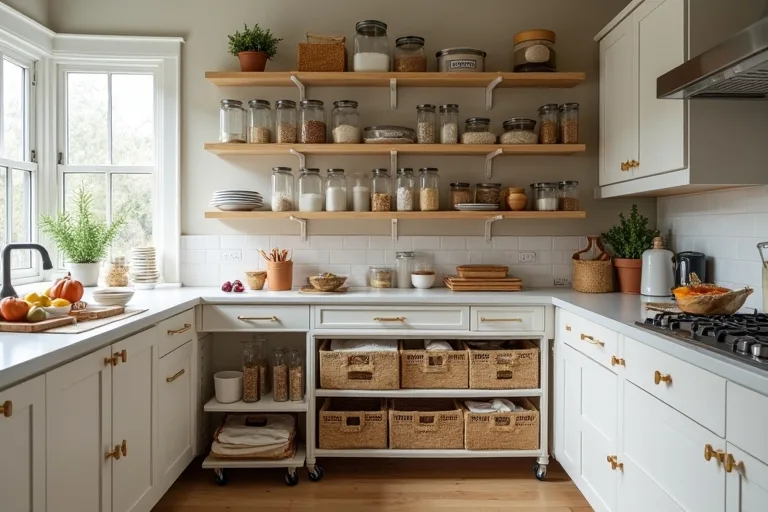
If you are deciding between buying containers or improving the pantry first, choose the option that fixes the biggest daily problem. If the issue is clutter, sort and zone the shelves. If the issue is reaching or overflow, add a rolling kitchen cart with storage or another flexible piece before you buy more matching bins.
Sort pantry items by use and frequency
Once the layout is clear, sorting becomes more effective. A pantry works better when items are grouped by how often they are used, not just by category. Daily items should be easiest to reach. Occasional items can go higher or lower. Backup stock belongs where it will not crowd the front of the shelf.
A simple approach usually works well:
- Keep daily-use food at eye level.
- Place breakfast, lunch, or snack items in their own zone.
- Store baking and cooking ingredients together.
- Move bulky or backup items to lower shelves.
- Use clear labels so families put things back in the right place.
This is also the point where airtight pantry food storage containers can help. They are useful for dry goods that need visibility, stackability, or protection from spills and moisture. But they are not automatically the right solution for every item. Canned food, unopened boxed goods, and items you rotate quickly may do better in the original packaging if the shelf system is already working.

Choose shelves, bins, containers, and labels with restraint
The best storage pieces support the system you already need. They should not create a new sorting project. Clear containers are helpful when you want fast visibility and a neat shelf line. Lidded bins work well for loose packets, snack items, or mixed-use shelves that need visual calm. Labels help most when several people use the pantry and items tend to migrate.
Think about what each storage piece is doing before you buy it. If the item will be opened and refilled often, a container may save time. If the item changes frequently, a bin may be better. If the item is heavy or hard to pour, a decanting container may be annoying rather than helpful. The goal is not uniformity; it is ease.
For readers who want a bit more structure before buying, the Room Makeover Planner, Home Layout Budget Spreadsheet (Digital Download) can be a useful way to compare storage options, layout changes, and budget priorities in one place. It is especially helpful if the pantry update is part of a wider kitchen refresh.
Add flexible storage for small or awkward kitchens
When the pantry is small, shallow, or shared with other kitchen needs, flexible storage can make a bigger difference than another set of matching containers. A rolling kitchen cart with storage is useful when you need extra shelf space without committing to a built-in change. It can hold overflow groceries, baking supplies, drinks, or the items you reach for during meal prep.
This kind of cart is most helpful when the pantry is not the only storage area in the kitchen. It can sit beside open shelving, tuck into a gap, or move closer to the prep area when needed. That flexibility matters in compact kitchens, rentals, and homes where the pantry layout cannot be fully redesigned.
If you are considering a cart, use it for the items that create friction in your current setup. That might be bulk dry goods, paper towels, lunch supplies, or containers you do not want taking up prime shelf space. The most useful storage is the one that clears a daily bottleneck, not the one that simply looks tidy.

Best next step
If your pantry feels crowded, start by checking whether the problem is layout, access, or overflow. That will tell you whether you need a better shelf plan, airtight containers, or a rolling kitchen cart with storage before you spend on more pieces that may not solve the real issue.
- Buying containers before deciding what the pantry actually needs to hold.
- Using the same storage for every item, even when some things need visibility and others need easy grab-and-go access.
- Putting daily items too high, too low, or behind bulky backup stock.
- Filling the pantry with labels and bins without leaving room for real use and turnover.
- Choosing fixed storage when a flexible cart would solve the problem more cleanly.
The smartest pantry organization ideas are the ones that make everyday use easier. Start with layout, sort by frequency, then choose only the storage that solves a real problem. For many kitchens, that means a mix of clear containers, simple labels, and one flexible piece such as a rolling kitchen cart with storage.
Helpful next tools and planners
If you want to make the decision easier before you buy
These options are most useful when you are comparing a pantry refresh with other kitchen planning decisions. Keep the focus on function first, then choose the product or planner that supports the way you actually use the space.
FAQ
Do I need airtight containers for every pantry item?
No. They are most useful for dry goods you open often, want to stack, or need to see at a glance. Many pantry items are fine in their original packaging if the shelf system is already organized.
What is the first thing to do when organizing a pantry?
Start by clearing the shelves and looking at how the pantry actually functions. Group items by use, not just by type, so you can see what belongs at eye level and what should move elsewhere.
Is a rolling kitchen cart with storage worth it?
It can be, especially in small kitchens or rentals. It adds flexible storage without requiring a built-in change and can hold overflow items that are crowding the pantry.
How do I stop the pantry from getting messy again?
Keep daily items easy to return, label shared zones, and leave a little open space for groceries. A pantry stays calmer when the system matches your household habits.
Three sensible next steps
Some links in this article may be affiliate links. Read more in the Affiliate Disclosure.