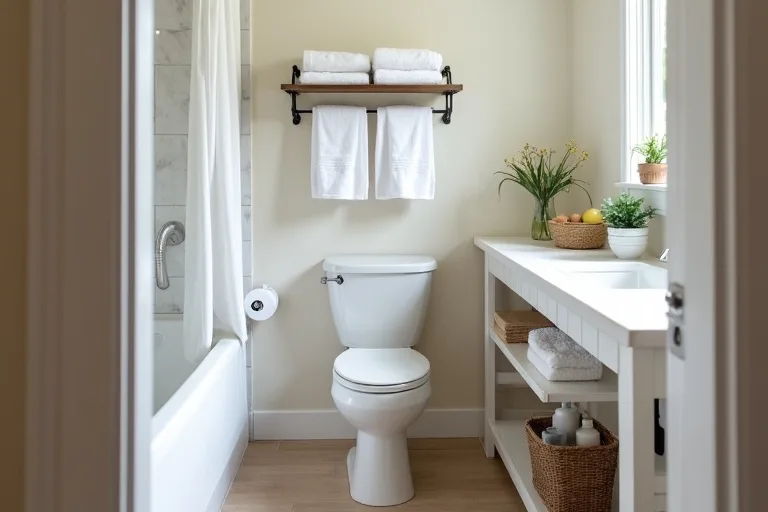
Small bathrooms usually feel cramped for one reason: the useful things have nowhere to go. When towels, toiletries, cleaning products, and spare essentials all compete for the same visible surfaces, the room starts to feel tighter than it really is.
The fix is not more storage everywhere. It is choosing a few calm, well-placed solutions that clear the counter, protect walking space, and keep daily items easy to reach.
Use vertical storage, closed bins, and one compact organizer to clear surfaces and improve flow. The easiest way to make a small bathroom feel bigger is to keep the counter open, move storage up the wall, and limit the number of items left in plain sight.
Start with the surfaces that feel busiest
The fastest way to improve a small bathroom is to remove clutter from the places you look at first: the vanity top, the sink ledge, and the floor around the toilet. These are the surfaces that make a room feel busy even when the actual storage problem is small.
Start by sorting items into three groups: daily-use, occasional-use, and should-be-stored-somewhere-else. Daily-use items belong within easy reach, but they do not need to sit out all the time. A soap dispenser, one toothbrush holder, and a single tray or container are usually enough for the counter.
Once the top surfaces are calmer, the whole room reads as more open. That matters more in a small bathroom than in almost any other room because visual space and physical space are so closely connected.
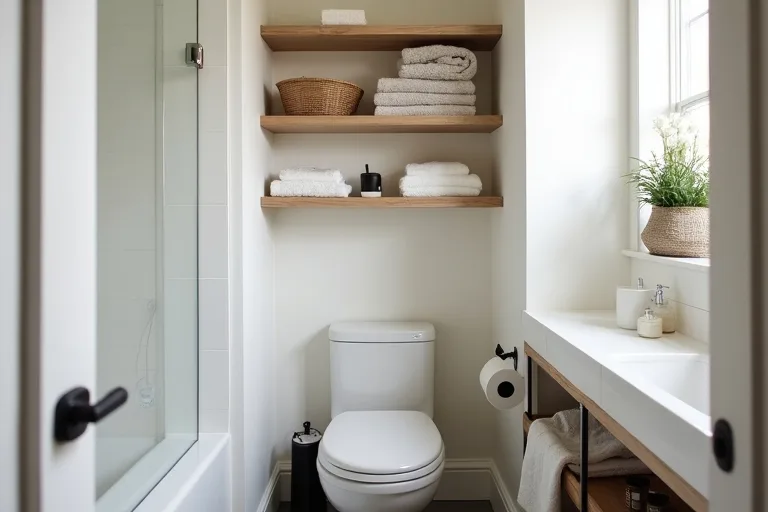
If you can clear the counter but then spread the same items across the back of the toilet, windowsill, and floor, the room will still feel crowded. The real decision is not where to place everything. It is what deserves to stay visible at all.
Use vertical storage without crowding the room
Walls are usually the most underused storage area in a small bathroom. A slim shelf, an over-toilet unit, or a shallow wall cabinet can add useful storage without taking away floor area. That is the key tradeoff: more storage is helpful only if it does not block movement or make the room feel boxed in.
Before you add anything tall, check the door swing, the clearance around the toilet, and how far you step in front of the sink. A storage piece can be technically small and still feel awkward if it sits in the wrong place.
Good vertical storage usually does one of three jobs:
- Holds backup supplies that do not need daily access.
- Keeps towels folded and close to where they are used.
- Uses the space above eye level, leaving the middle of the room visually lighter.
A simple wall shelf can work well if the items on it stay neat. If the contents are mixed or visually busy, a closed cabinet or lidded bin is usually a better choice.
Choose bins and organizers that make things easier to use
Small bathroom storage works best when each category has a clear home. That is where bins, drawer inserts, and compact cube organizers can help. They prevent items from drifting around the room and make it much easier to keep the bathroom tidy with minimal effort.
A practical option is an 8 cube storage organizer used as a simple utility piece in a larger bathroom or a very well-measured compact space. It can hold folded towels, backup toiletries, and cleaning supplies when the layout allows it. If you want the storage to look calmer and work harder, pair it with fabric storage bins set for cube organizer so the contents are hidden and easier to sort.
This is where closed storage usually beats open storage. Open shelves can look neat when they hold a few folded towels or matching baskets. But once you start storing mixed bottles, paper goods, or daily extras, the shelf can begin to add visual noise instead of removing it.
If you are planning a more flexible setup, a small layout tool can help you see how much wall and floor space you actually have before you buy. A digital planning sheet like the Small Space Furniture Planner, Room Layout Spreadsheet (Digital Download) is useful if you want to map out storage first and shop second.

Plan the layout before you buy anything
In a small bathroom, the best storage choice is often the one that protects movement first. If a cabinet, shelf, or basket makes you turn sideways at the doorway or reach awkwardly past the sink, it is probably too much for the room.
A simple buying order keeps the process calmer:
- Measure the wall, floor, and door-clearance space.
- Sort what needs daily access and what can be stored elsewhere.
- Choose one main storage solution for the biggest category.
- Add only the smallest extras needed to support the system.
That sequence keeps the room from filling up with storage pieces that solve the wrong problem. It also makes it easier to match your choices to the way the bathroom actually gets used.

Best next step
Before you buy shelves, bins, or a compact organizer, measure the bathroom as a layout problem first. The simplest way to do that is with a room planner so you can check wall space, floor space, and door clearance before anything arrives.
- Buying storage before measuring the room.
- Leaving too many daily items on the counter.
- Using open shelves for clutter-prone items.
- Choosing a storage piece that blocks the door or walking path.
- Adding more bins without deciding what each one is for.
Small bathroom storage works best when it reduces visual clutter and protects flow at the same time. Clear the counter first, use vertical space carefully, choose closed bins for anything mixed or messy, and measure before you buy. If the room feels easier to move through, it will usually feel bigger too.
Helpful next tools and planners
If you want to make the decision easier before you buy
A few practical tools can help you choose storage that fits the room instead of crowding it. Start with planning, then move into the few products that match the space you actually have.
FAQ
What storage makes a small bathroom feel bigger?
Storage that clears the counter, uses wall space well, and keeps the floor as open as possible usually has the biggest effect. Closed bins and slim vertical units are often better than bulky open pieces.
Are open shelves a good idea in a small bathroom?
They can be, but only if you keep what is on them simple and tidy. Towels and matching baskets work better than mixed bottles or loose items.
Should I use bins or drawers for bathroom storage?
Use bins for grouped items that you do not need to access constantly. Use drawers or inserts for smaller daily items that would otherwise scatter across the counter.
What should I measure before buying bathroom storage?
Measure the wall space, floor footprint, door swing, and the clearance around the sink and toilet. Those four checks prevent most storage mistakes in a small bathroom.
Three sensible next steps
Some links in this article may be affiliate links. Read more in the Affiliate Disclosure.